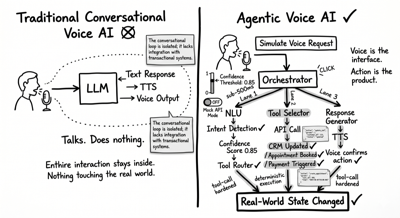
The keyboard had 50 years. The touchscreen had 15. Voice is next — and the infrastructure to make it production-grade is already here.
The keyboard had 50 years. The mouse had 40. The touchscreen had 15. Each one redefined how humans interact with computers — not because it was smarter, but because it removed friction. Voice removes all of it. No learning curve. No menus. No navigation hierarchy. Just intent, stated in the most natural medium humans have ever had: spoken language. Voice is not the next feature. It is the next UI.
The reason this has not happened yet is not that voice recognition is hard — it is mostly solved. The reason is that nobody has built the layer between voice and action reliably enough for production. Transcription is not intelligence. Responding with text is not acting. The gap between "the AI understood me" and "the AI did the thing" is where every voice platform breaks down. That gap is exactly what Vanira is engineered to close.
"Voice is not the next feature. It is the next UI. And we are building the infrastructure that makes it real — not in a demo, in production."
The SDK That Turns Voice Into Actions
The Vanira SDK ships one entry point: VaniraClient. You give it an agentId and an apiKey, call connect(), and you have a live, bidirectional voice AI session — ICE negotiation, DTLS handshake, SRTP audio streaming, and a structured data channel, all handled. What you get back is not a transcript stream. You get an agent that is aware of your application, capable of commanding your UI, and responsive to everything your user does on screen.
Under the hood, the session runs two simultaneous channels. The SRTP audio track carries the human voice. The WebRTC data channel carries four typed primitives that together define what it means for voice to be a UI: client_tool_call (the agent commands your interface), client_tool_ack (your interface confirms), sendContextUpdate (your app tells the agent what the user is seeing), and sendActionTrigger (a user action on your UI forces an immediate agent response). These are not webhook events. They are synchronous, session-bound, typed messages in a shared runtime.
The Agent That Knows What Your UI Shows
The feature that makes Vanira architecturally distinct is the blocking client tool call. When the agent fires onClientToolCall with execution_mode "blocking", its speech pipeline fully suspends. It does not guess what happened. It does not generate a generic response and move on. It stops and waits for your application to call sendToolResult(tool_call_id, result) with the actual outcome of the UI action.
Only after receiving that result does the agent continue — now speaking from ground truth. "I have opened the pricing comparison. You should see the Pro and Enterprise plans side by side right now." That sentence is not pre-written. It is generated from the real { success: true } your code returned after the modal opened. If the action fails, the agent knows that too, and responds accordingly. An agent that knows what your UI actually shows is categorically different from one that assumes.
T_ack_deadline = T_tool_call_received + 2300ms if (T_ack_sent > T_ack_deadline): agent.emit("Did something pop up?")
The 2.3s ack contract — if your UI misses the deadline, the agent self-heals with a natural recovery prompt. No crash, no hang.
Context Sync: The Agent That Sees What You See
sendContextUpdate() is how your application gives the agent ambient awareness without interrupting it. Call it on navigation events, scroll milestones, cart updates, map movement — the agent absorbs the state silently. No interruption to the conversation. No API call. The user scrolls to a product — the agent already knows. The user navigates to the pricing page — the agent already knows. When the user finally asks a question, the agent answers from a context that is current, not stale.
sendActionTrigger() is the active channel. When a user clicks something meaningful — a map location, a product card, a search result — you call triggerActionInterrupt() to cut the agent mid-sentence, then sendActionTrigger(action_name, { prompt }) to inject a directive into the agent with full context authority. "User clicked on Hyderabad on the map. Tell them 2 compelling facts about it right now." The agent responds in under 300 milliseconds. A click on your UI becomes a voice response. This is what Voice as a UI actually feels like.
We Are Making It Real, Today
Every major UI paradigm required infrastructure that took years to mature. The web needed browsers. Mobile needed app stores and touch SDKs. Voice needs a reliable action layer — one that bridges the gap between spoken intent and application state without hallucination, without silent failures, without stochastic drift. That infrastructure exists. It is the Vanira SDK.
We are not waiting for voice to "become mainstream." We are building the platform that makes it inevitable. Three lines of code — new VaniraClient({ agentId, apiKey }), connect() — and your application has an agent that listens to your users, understands what they are looking at, commands your interface with typed actions, and speaks from what actually happened on screen. Voice is the next UI. We are making it real.
Technical Engineering Specs
new VaniraClient({ agentId, apiKey }) + connect(). Full agentic voice session — zero boilerplate.
Agent suspends speech, waits for UI ground truth from sendToolResult(), then responds from reality.
triggerActionInterrupt() + sendActionTrigger() — UI click to live agent voice response.
sendContextUpdate() on every nav/scroll/viewport — agent always knows what the user sees.
Experience the Intelligence
Don't just read about the engineering. Test the Vanira Core directly in your browser. Our demo agent handles multi-step tool execution with the exact protocols described above.
Start Engineering Your Voice OS
Vanira is now in open beta. Create your agents, configure your tool-calls, and integrate the SDK in minutes.