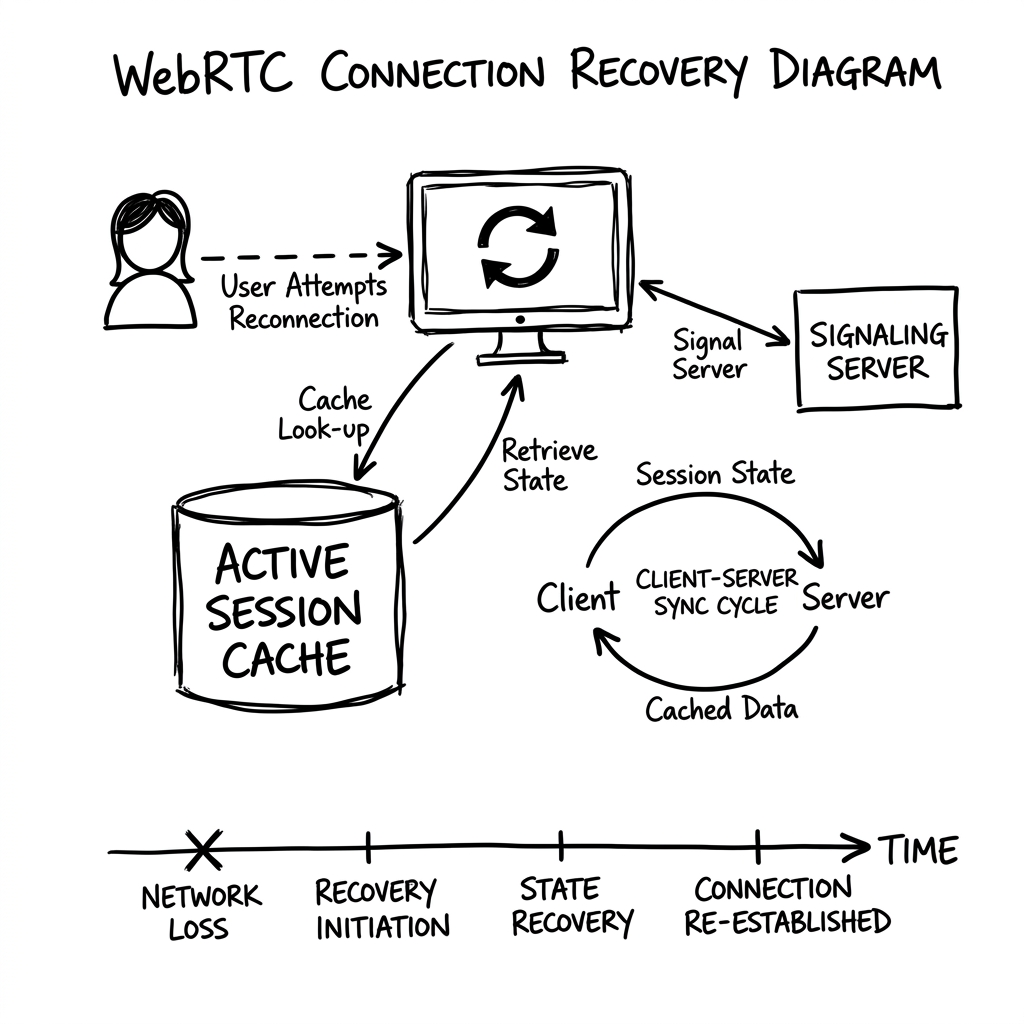
How we solved the connection-drop problem in single-page apps (SPAs) by implementing persistent session caching, secure state handshake, and agent-side dialogue memory.
WebRTC is built on transient peer connections. By design, the moment a page is reloaded, a route transition triggers a component unmount, or network state switches, the RTCPeerConnection terminates. For simple video conferencing, the user simply rejoins. But for an agentic voice session—where the AI has spent minutes gathering customer details, executing blocking UI actions, and building dialogue state—a connection drop is a catastrophic failure. The user starts over from "Hello".
Solving this without maintaining expensive, long-lived server-side streaming contexts for dead sockets required us to architect a client-backed session recovery pipeline. We call it Session Continuity.
The Session Caching Lifecycle
The client-side recovery relies on a dual-tier storage cache. We partition transient connection state into tab-scoped (sessionStorage) and persistent (localStorage) stores. Upon initiating a connection, the SDK automatically caches the unique prospect and session identifiers under the keys vanira_prospect_id and vanira_latest_call_id.
This separation ensures that if a user opens a new browser tab, they receive a fresh agent context, but if they refresh their current tab or navigate around the SPA, the SDK automatically recovers the existing active session state.
"A natural conversation cannot survive page reloads if it has to restart from zero. Continuity bridges the gap between web routers and continuous WebRTC sockets."
The Pre-Flight Handshake
When a page mounts or a route transition completes, the SDK performs a pre-flight verification step before opening a new WebSocket/WebRTC connection. Instead of sending a blank creation request, it posts the cached prospect and session identifiers to the backend call validation endpoint.
If the backend confirms that the dialogue thread is still active on the agent coordinator (within our 10-minute expiry window), the orchestrator resolves the existing thread context. Instead of instantiating a new LLM thread, it hooks the new RTCPeerConnection directly into the suspended dialog runtime, bypassing the initial prompt state.
T_expiry = T_last_interaction + 600s if (T_current < T_expiry): session.recover(call_id) else: session.initialize_new()
State recovery time contract — active sessions are persistent for 10 minutes from the last interaction event.
Graceful Reconnection and Silence
Once the handshake completes, the new WebRTC SDP exchange is conducted. During this window—which averages under 1.2 seconds—the agent does not start talking. The conversation history is already loaded, but the speech synthesis engine is instructed to maintain silent hold. Only when the WebRTC datachannel signals connection open does the agent resume. To the user, it feels like a brief pause, not a dropped call. The conversational state remains perfectly unified.
Mitigating Network Switches and Jitter
In mobile environments, users frequently switch between Wi-Fi and 5G networks, leading to transient socket closures. Our client-side recovery framework listens directly to the network status API. When a network switch is detected, the SDK queues outgoing WebRTC data channel events and registers a warm recovery token.
The moment the new IP address resolves, the peer connection is renegotiated. Because the agent-side dialogue state has cached the user's last spoken phrase, it picks up precisely where it left off, preventing the caller from experiencing any conversation lapse.
Technical Engineering Specs
Average duration from page reload/route change to active audio track resumption.
Dialogue and transaction context preserved seamlessly across reconnect handshakes.
Pure client-side storage cache footprint using standard browser window storage.
Time window during which an inactive socket connection can be recovered.
Experience the Intelligence
Don't just read about the engineering. Test the Vanira Core directly in your browser. Our demo agent handles multi-step tool execution with the exact protocols described above.
Start Engineering Your Voice OS
Vanira is now in open beta. Create your agents, configure your tool-calls, and integrate the SDK in minutes.