
Introduction
High-volume teams hit the same wall: phone demand grows faster than hiring. An automated call system routes, places, and manages calls with software—so people handle exceptions, not every reset, reminder, or status check.
Modern platforms combine cloud telephony, conversational AI, and CRM context. Legacy menu trees still exist, but enterprises are moving to AI Voice Agents that understand natural speech and complete tasks during the call.
This guide covers how automated calling works, where legacy tools fail, and how Vanira delivers agentic voice automation for inbound and outbound programs.
What Is an Automated Call System?
Software that initiates, receives, and controls phone conversations with minimal manual steps. It connects to carriers, runs workflows (greet → understand intent → act or escalate), and logs outcomes to your stack.
Today's systems layer AI customer support, AI IVR, and contact center automation on one orchestration layer—not just playback and keypad trees.
How Automated Call Systems Work
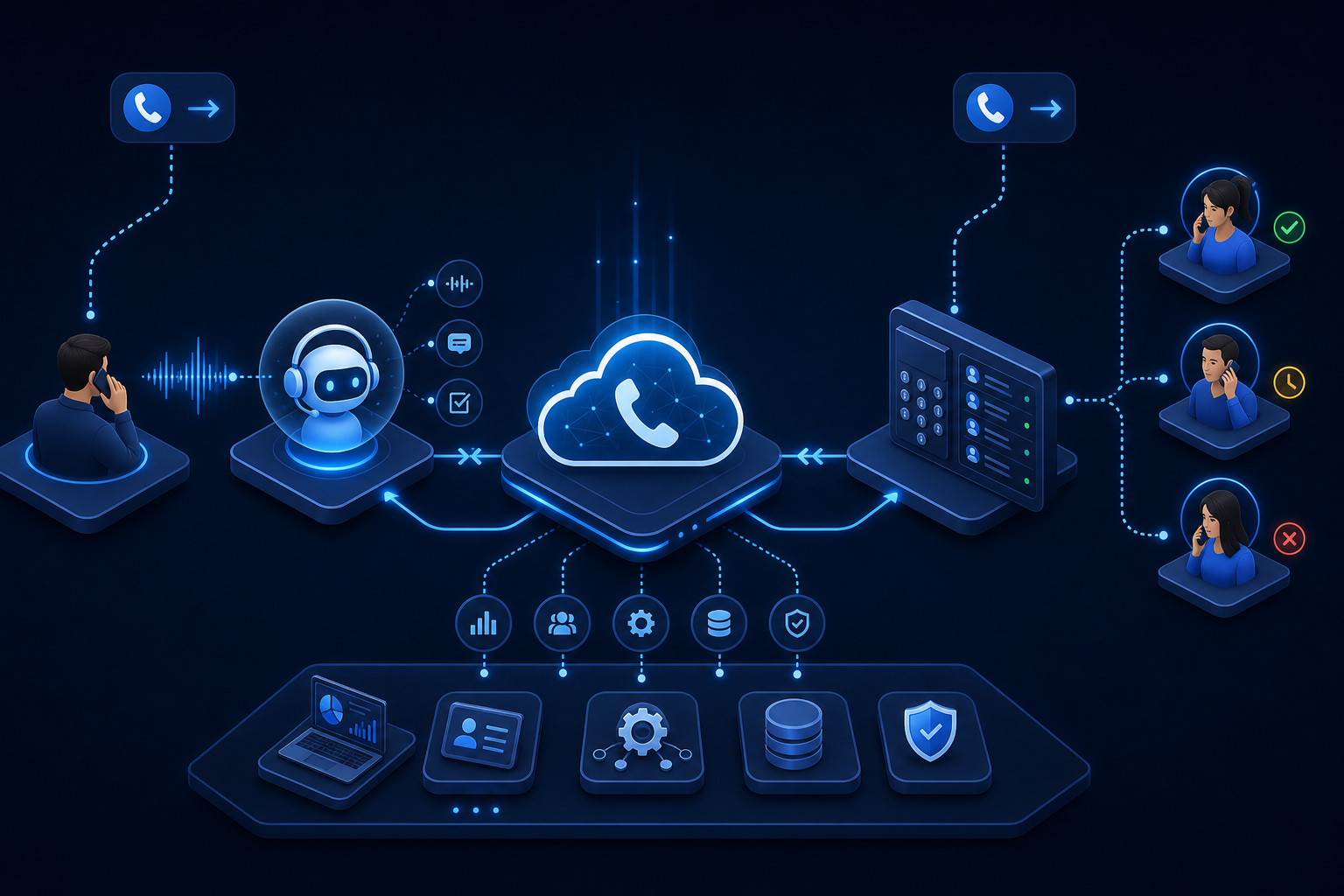
Inbound: Caller hits your number → platform identifies them → AI IVR or voice agent resolves or warm-transfers with context → CRM/ticket updated.
Outbound: Triggers select contacts with compliance rules → dialer places calls → agent delivers contextual dialog → dispositions sync for follow-up.
Shared building blocks: telephony, low-latency speech, workflow engine, integrations, and analytics. Strong programs add persistent memory and omnichannel communication so voice does not start from zero every time.
Key Components of a Modern Automated Call System
| Component | Role |
|---|---|
| Telephony & numbering | Connectivity, local presence, compliance |
| Speech stack | ASR, TTS, natural turn-taking |
| Dialog & orchestration | Policies, tools, escalations |
| Integrations | CRM, billing, scheduling, tickets |
| Analytics & governance | Containment, QA, security, retention |
Evaluate vendors on how these pieces work together—not on a single flashy demo.
Traditional Automated Call Systems vs AI-Powered Automated Call Systems
| Dimension | Traditional (DTMF / static IVR) | AI-powered (agentic voice) |
|---|---|---|
| Input mode | Keypad menus, limited speech | Natural speech, flexible intent |
| Change velocity | Weeks per prompt change | Hours with guardrails & testing |
| Personalization | Segment-level | Account-level, memory-aware |
| Failure mode | "Invalid option" loops | Clarification, handoff, callback |
| Outbound | Robotic, one-size script | Contextual dialog, objection handling |
| Analytics | Press-path metrics | Intent, sentiment, outcome quality |
| Integration | Often batch / delayed | Real-time tools & CRM writes |
| Dimension | Traditional (DTMF / static IVR) | AI-powered (agentic voice) |
|---|---|---|
| Input mode | Keypad menus, limited speech | Natural speech, flexible intent |
| Change velocity | Weeks per prompt change | Hours with guardrails & testing |
| Personalization | Segment-level | Account-level, memory-aware |
| Failure mode | "Invalid option" loops | Clarification, handoff, callback |
| Integration | Often batch / delayed | Real-time tools & CRM writes |
Hybrid deployments are normal: keep keypad paths for rigid disclosures; use conversational AI where questions vary.
Benefits of Using an Automated Call System
- Scale tier-1 intents without linear headcount growth
- Speed outbound follow-up while intent is fresh
- Consistency policy-accurate messaging on every call
- Insight structured intent and outcome data, not just volume metrics
Benefits compound when calls trigger workflow automation—tickets, refunds, bookings—during the conversation.
Common Use Cases

Customer support — Order status, FAQs, resets with CRM-backed answers; escalate on frustration or VIP rules. See hospitals for regulated care patterns.
Appointment reminders — Confirmations and reschedules for healthcare, field service, and salons.
Lead qualification — Capture fit, budget, timeline; push scored meetings to sales.
Payment collection — Compliant identity checks and promise-to-pay; see collections.
Healthcare, education, logistics — Scheduling, fee reminders, delivery exceptions—often multilingual.
Challenges Businesses Face With Legacy Calling Systems
Deep IVR menus, brittle scripts, siloed channels, and batch integrations create repeat callers and compliance risk. Bolting one speech bot onto old orchestration rarely fixes the underlying data latency.
Why AI Is Transforming Automated Call Systems
Better real-time speech, tool-using agents (APIs + CRM writes), and flat support budgets push teams toward autonomous containment—with human oversight, kill switches, and QA sampling.
How Vanira Powers Intelligent Automated Call Systems
Vanira is an agentic voice AI platform for automated inbound and outbound calling, AI IVR, omnichannel communication, CRM integrations, persistent memory, workflow automation, and enterprise scale.
Pilot one high-volume intent, measure containment, then expand. Developers embed via APIs; operators control guardrails and disclosures. Explore BFSI and education playbooks.
Feature Comparison Table
| Feature | Traditional System | Vanira |
|---|---|---|
| Natural language understanding | Limited / add-on | Native, real-time |
| Outbound & inbound parity | Often separate products | Unified platform |
| CRM & tool integrations | Batch, custom dev | Real-time, API-first |
| Conversation memory | None or agent-only | Persistent, cross-channel |
| Multilingual | Costly voice talent | Built-in multilingual agents |
| Workflow & browser actions | Rare | Supported |
| Iteration cycle | Weeks | Hours with staging & QA |
| Human handoff | Blind transfer | Context-rich warm transfer |
| Analytics | Path presses | Intent, outcome, quality |
| Scalability | Hardware-bound | Cloud-native elasticity |
Why Businesses Choose Vanira
Faster pilots, operator-controlled guardrails, multilingual voice, and APIs for product-embedded calling—not another multi-year IVR migration.
Start Building Smarter Voice Automation With Vanira
Automate inbound and outbound calls with agentic AI voice agents, improve customer experiences through natural real-time conversations, and scale operations with CRM integrations, persistent memory, and workflow automation—all on one enterprise voice platform.
Frequently Asked Questions
Conclusion
An automated call system wins on first-contact resolution, scale, and auditability—not menu depth. Start with one intent, measure honestly, and expand with guardrails. Vanira provides the agentic voice layer to make that operational.