Introduction
Most call centers are still built around the same constraint: a human has to be on the line. The best call center AI for voice-based support removes that constraint—replacing hold queues and rigid menus with voice agents that understand natural speech, act on real-time data, and hand off intelligently when a human adds genuine value.
This guide covers what separates good call center AI from great, how to evaluate vendors, and why Vanira is built for production-grade voice support at enterprise scale.
What Makes the Best Call Center AI for Voice-Based Support?
Not all call center AI is equal. The best platforms share five traits:
1. Natural language understanding — Goes beyond keyword routing. The AI understands what the caller means, not just what they said.
2. Agentic task completion — The AI doesn't just route—it resolves. Bookings, payments, status lookups, and account updates happen during the call via connected tools.
3. Real-time CRM integration — Customer context loads before the first word. Outcomes write back the moment the call ends.
4. Graceful human handoff — When escalation is right, the handoff carries full context—no repeat questions, no blind transfers.
5. Operator control — Non-technical teams can update scripts, guardrails, and disclosures in hours, not weeks.
How AI-Powered Call Centers Work
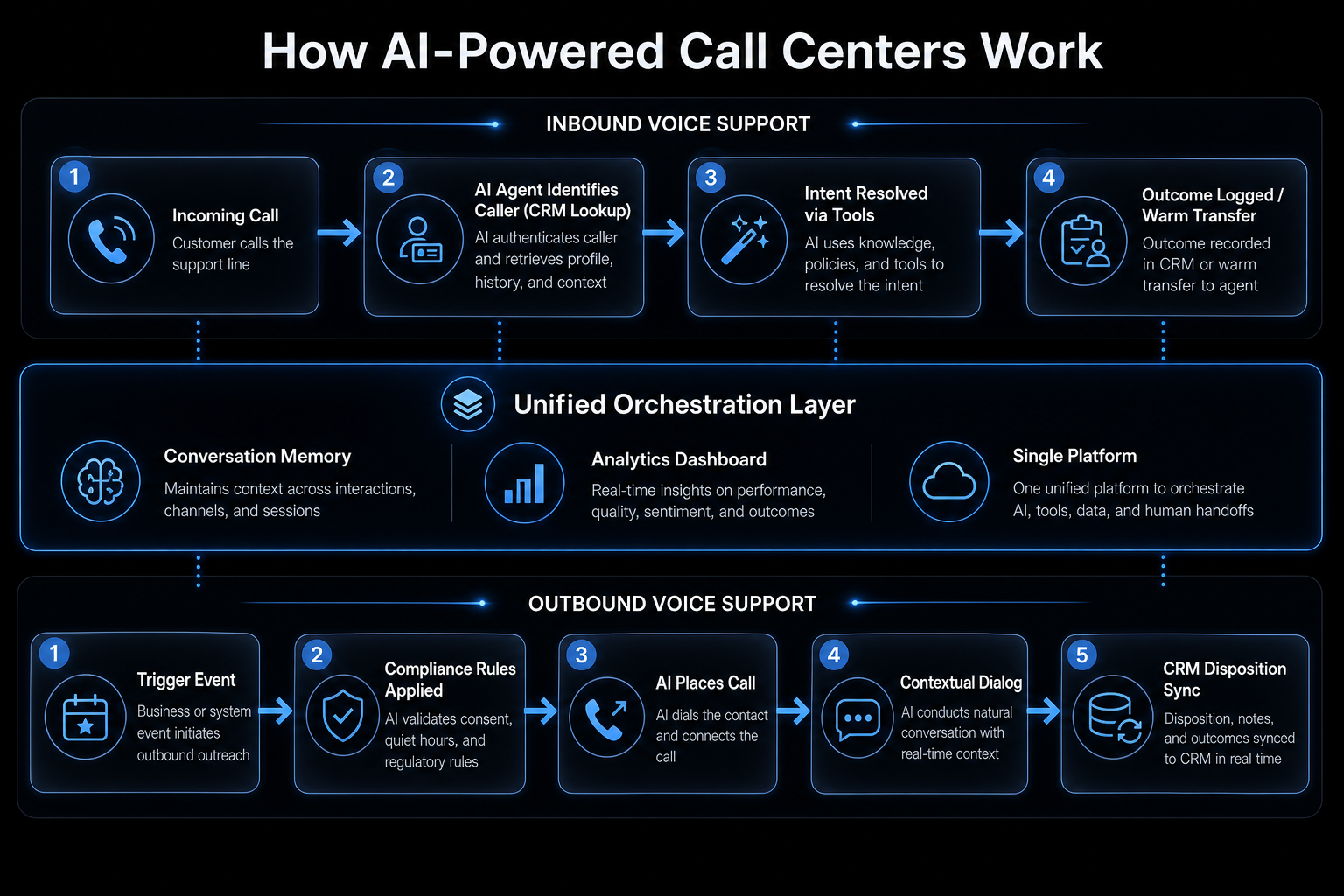
Inbound: Caller reaches your number → AI agent identifies them via caller ID and CRM lookup → intent is resolved using connected tools (scheduling, billing, ticketing) → outcome logged, call closed or warm-transferred with full context.
Outbound: Trigger fires (overdue payment, expiring contract, appointment due) → AI agent places the call with compliance rules applied → contextual dialog runs → disposition synced to CRM for follow-up.
Both flows share the same orchestration layer, conversation memory, and analytics—so you manage one platform, not two products.
Traditional Call Centers vs AI Voice Support
| Dimension | Traditional Call Center | AI Voice Support |
|---|---|---|
| First response | Hold queue, average 4–8 min | Instant, 24/7, no hold time |
| Intent understanding | Keypad menus or keyword IVR | Natural speech, flexible intent |
| Personalization | Agent reads screen manually | CRM context loaded before first word |
| Task resolution | Human action required | Autonomous completion via tools |
| Consistency | Varies by agent and shift | Policy-accurate on every call |
| Multilingual | Separate teams or outsourcing | Single platform, multiple languages |
| Cost per interaction | High—headcount-bound | Low—near-zero marginal cost |
| Dimension | Traditional Call Center | AI Voice Support |
|---|---|---|
| First response | Hold queue, 4–8 min average | Instant, 24/7, no hold |
| Intent understanding | Keypad menus or keyword IVR | Natural speech, flexible intent |
| Personalization | Agent reads screen manually | CRM context loaded before first word |
| Task resolution | Human action required | Autonomous completion via tools |
| Cost per interaction | High—headcount-bound | Low—near-zero marginal cost |
Hybrid operations are the norm: AI handles repeatable tier-1 volume while humans focus on complex, sensitive, or high-value conversations.
Key Features to Look For in a Call Center AI
| Feature | Why It Matters |
|---|---|
| Low-latency speech | Natural turn-taking; callers won't wait 2 seconds for a response |
| Tool-using agents | Task completion without human intervention |
| Persistent memory | Context across calls so callers never repeat themselves |
| Multilingual voice | Serve global customers without separate teams |
| Compliance tooling | Consent, DNC, retention—built in, not bolted on |
| QA and analytics | Intent rates, containment, and outcome quality—not just AHT |
Evaluate vendors on integration depth, iteration speed, and how they handle failure cases—not on a polished demo with a cherry-picked script.
Top Use Cases for AI Voice Support
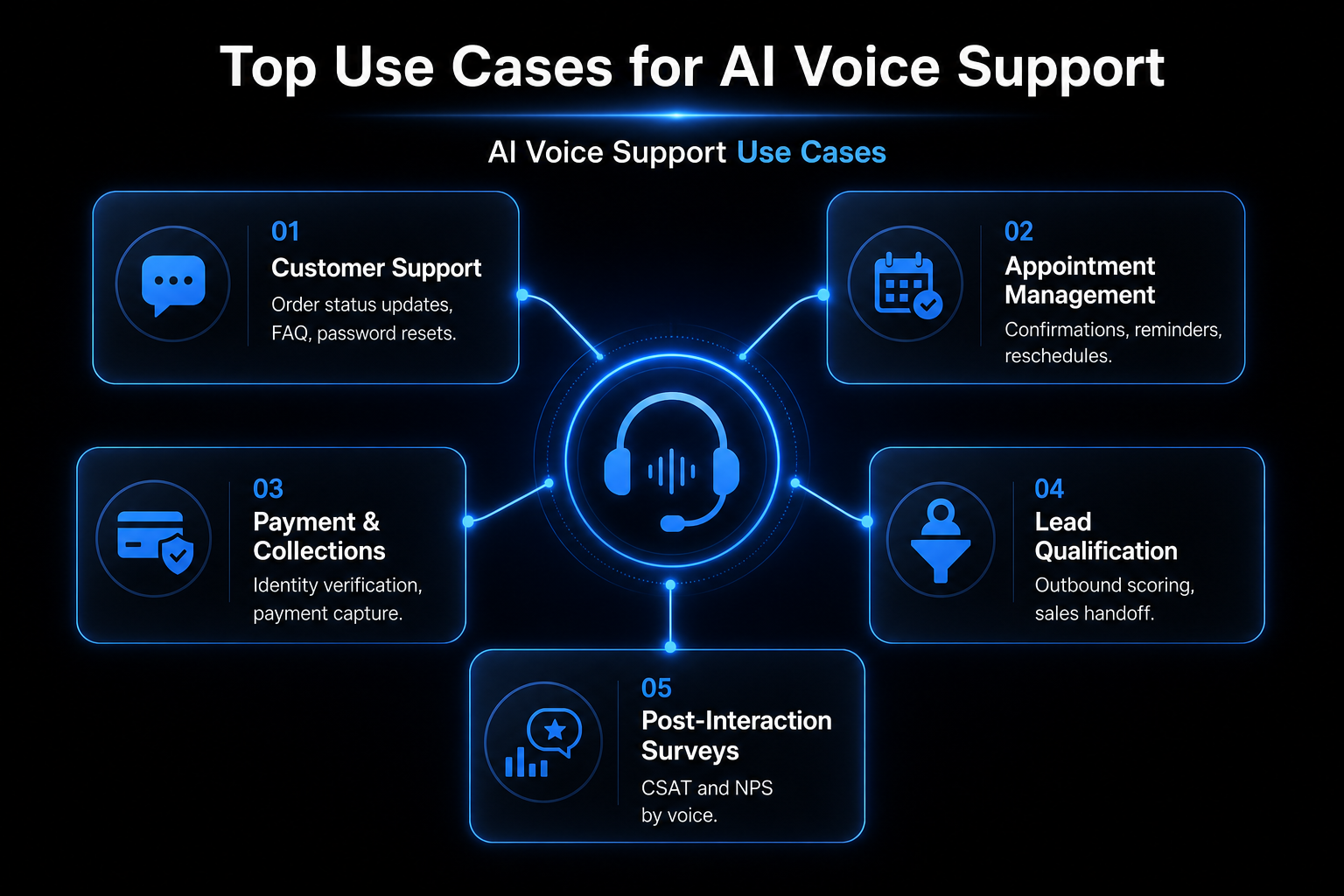
Customer support — Order status, account updates, FAQ resolution, password resets. AI resolves with CRM context; escalates on VIP rules or frustration signals.
Appointment management — Confirmations, reminders, and reschedules across healthcare, field service, education, and salons.
Payment and collections — Compliant identity verification, payment capture, and promise-to-pay recording. See collections for regulated deployment patterns.
Lead qualification — Capture budget, fit, and timeline during an outbound call; push scored meetings to sales without a human dialer team.
Post-interaction surveys — CSAT and NPS collected by voice immediately after resolution—when the experience is freshest.
How to Evaluate Call Center AI Vendors
Ask for a containment number on real traffic—not a sandbox demo. Containment rate on live calls is the only metric that proves production readiness.
Test the failure path. What happens when the caller says something unexpected? The best AI clarifies, retries gracefully, and transfers with context. Poor AI loops or drops the call.
Check integration depth. Can the AI write to your CRM mid-call? Can it trigger a ticket or push a calendar invite before the caller hangs up?
Verify iteration speed. How long does it take to change a script or add a compliance disclosure? The answer should be hours, not a change request to the vendor.
How Vanira Powers the Best AI Call Center for Voice Support
Vanira is an agentic voice AI platform built for production call centers. It combines low-latency speech, real-time CRM integration, persistent conversation memory, multilingual agents, and operator-controlled guardrails—inbound and outbound on one unified platform.
Start with one high-volume intent, measure containment on real traffic, and expand queue by queue. Explore industry playbooks for BFSI, hospitals, collection agencies, and educational institutes.
Feature Comparison Table
| Feature | Legacy Call Center | Vanira AI |
|---|---|---|
| Natural language understanding | Limited / keyword routing | Native, real-time NLU |
| Inbound + outbound | Separate products | Unified platform |
| CRM integration | Post-call batch sync | Real-time read & write |
| Task completion | Human agent required | AI agent via connected tools |
| Conversation memory | None or session-only | Persistent, cross-channel |
| Multilingual support | Costly voice talent per language | Built-in, 20+ languages |
| Human handoff | Blind transfer | Context-rich warm transfer |
| Iteration speed | Weeks per change | Hours with operator controls |
| Analytics | AHT, call volume | Intent, containment, outcome |
| Scale model | Linear headcount growth | Cloud-native, elastic |
Why Businesses Choose Vanira
No separate inbound and outbound products. No per-language fees. No multi-year IVR migration. Vanira pilots in weeks, proves containment on real traffic, and gives operators the controls to expand confidently—without waiting on vendor engineering cycles.
Start Building Smarter Voice Automation With Vanira
Replace your hold queue with an AI voice agent that resolves tier-1 volume, integrates with your CRM in real time, and hands off with full context—on one unified platform for inbound and outbound call center support.
Frequently Asked Questions
Conclusion
The best call center AI for voice-based support isn't the one with the most features in a brochure—it's the one that contains real calls, integrates with real systems, and gives your team real control. Vanira is built for exactly that: production voice AI that proves ROI on the first pilot and scales from there.