Introduction
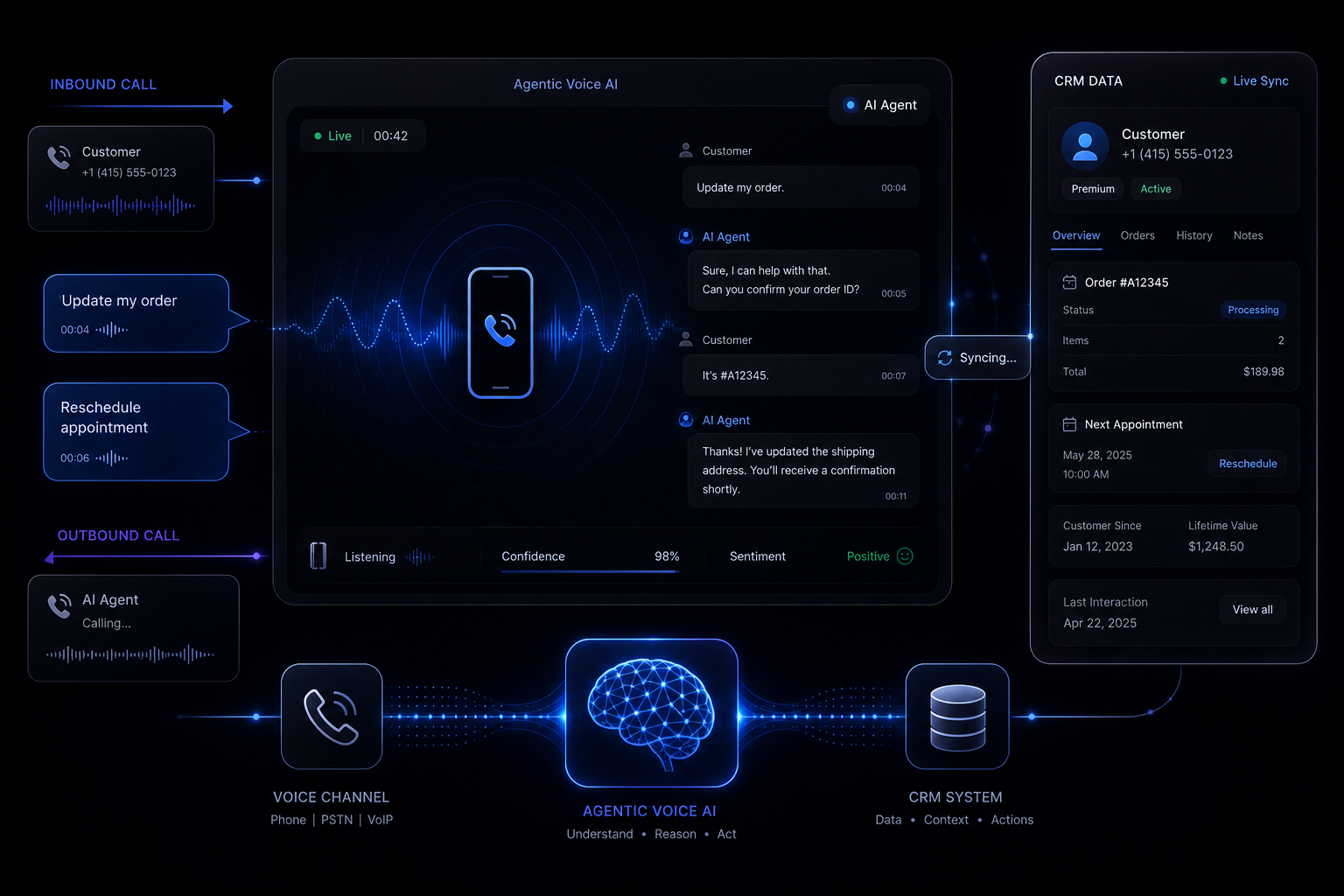
The phone call isn't going anywhere—but the agent answering it is changing. An AI call replaces scripted menus and hold queues with a voice agent that understands what the caller actually says, takes action using real-time data, and only escalates when a human adds genuine value.
This guide explains how AI calls work, where traditional systems fall short, and how Vanira delivers agentic AI calling for enterprise inbound and outbound programs.
What Is an AI Call?
An AI call is a phone interaction managed by an agentic voice AI—not a pre-recorded script or a keypad menu. The AI listens, understands intent in natural language, queries connected systems (CRM, billing, scheduling), and resolves the call autonomously or transfers to a human with full context.
AI calls span both directions: inbound AI calls answer customers without hold time, and outbound AI calls proactively reach contacts for reminders, follow-ups, or qualification—at scale, without a dialer full of human agents.
How AI Calls Work
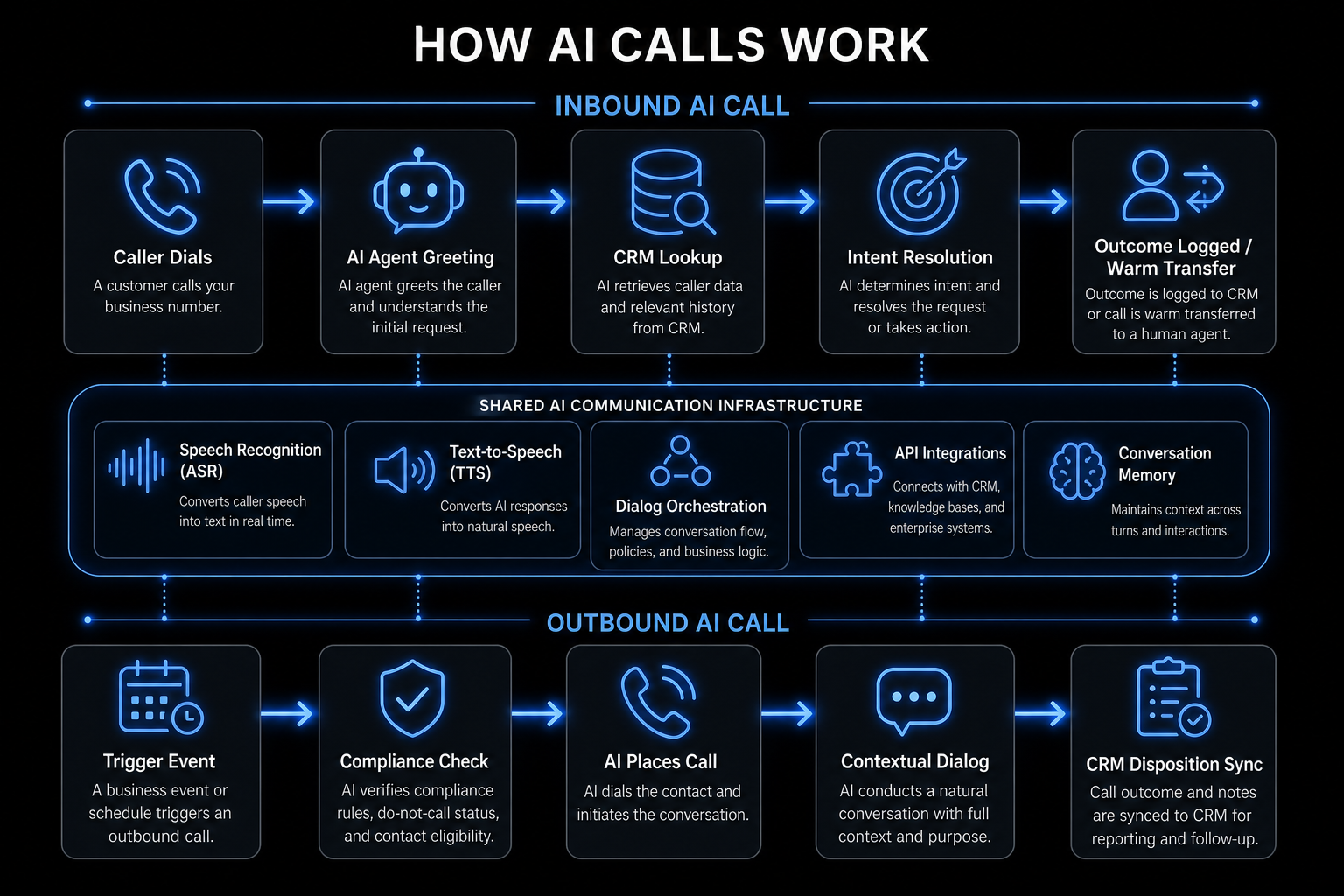
Inbound flow: Caller dials your number → AI voice agent greets and identifies them using caller ID + CRM lookup → agent resolves the intent (update, booking, status check) using connected tools → outcome logged, call ends or warm-transfers with context.
Outbound flow: Trigger fires (appointment due, payment overdue, lead scored) → AI agent places the call with compliance rules applied → contextual dialog runs → disposition synced to CRM for follow-up.
Shared infrastructure: low-latency speech recognition, text-to-speech, a dialog orchestration engine, real-time API integrations, and persistent conversation memory so the AI never asks for information the caller already provided.
Traditional Phone Calls vs AI Calls
| Dimension | Traditional Phone Call | AI Call |
|---|---|---|
| Conversation style | Scripted menus or hold queue | Natural dialog, flexible intent |
| Task completion | Human agent required | Resolved during the call by AI |
| Caller experience | Long hold times, repeat info | Instant response, context-aware |
| Personalization | Segment-level scripts | Account-level, memory-driven |
| Outbound quality | Robotic, one-size script | Contextual dialog, objection handling |
| Integration depth | Batch or manual entry | Real-time CRM and tool calls |
| Cost to scale | Linear with headcount | Near-zero marginal cost |
| Dimension | Traditional Phone Call | AI Call |
|---|---|---|
| Conversation style | Scripted menus or hold queue | Natural dialog, flexible intent |
| Task completion | Human agent required | Resolved during the call by AI |
| Caller experience | Long hold times, repeat info | Instant response, context-aware |
| Personalization | Segment-level scripts | Account-level, memory-driven |
| Cost to scale | Linear with headcount | Near-zero marginal cost |
Hybrid approaches are common: keep humans for sensitive, complex, or high-value calls while AI handles the high-volume, repeatable tier-1 work.
AI Call Use Cases
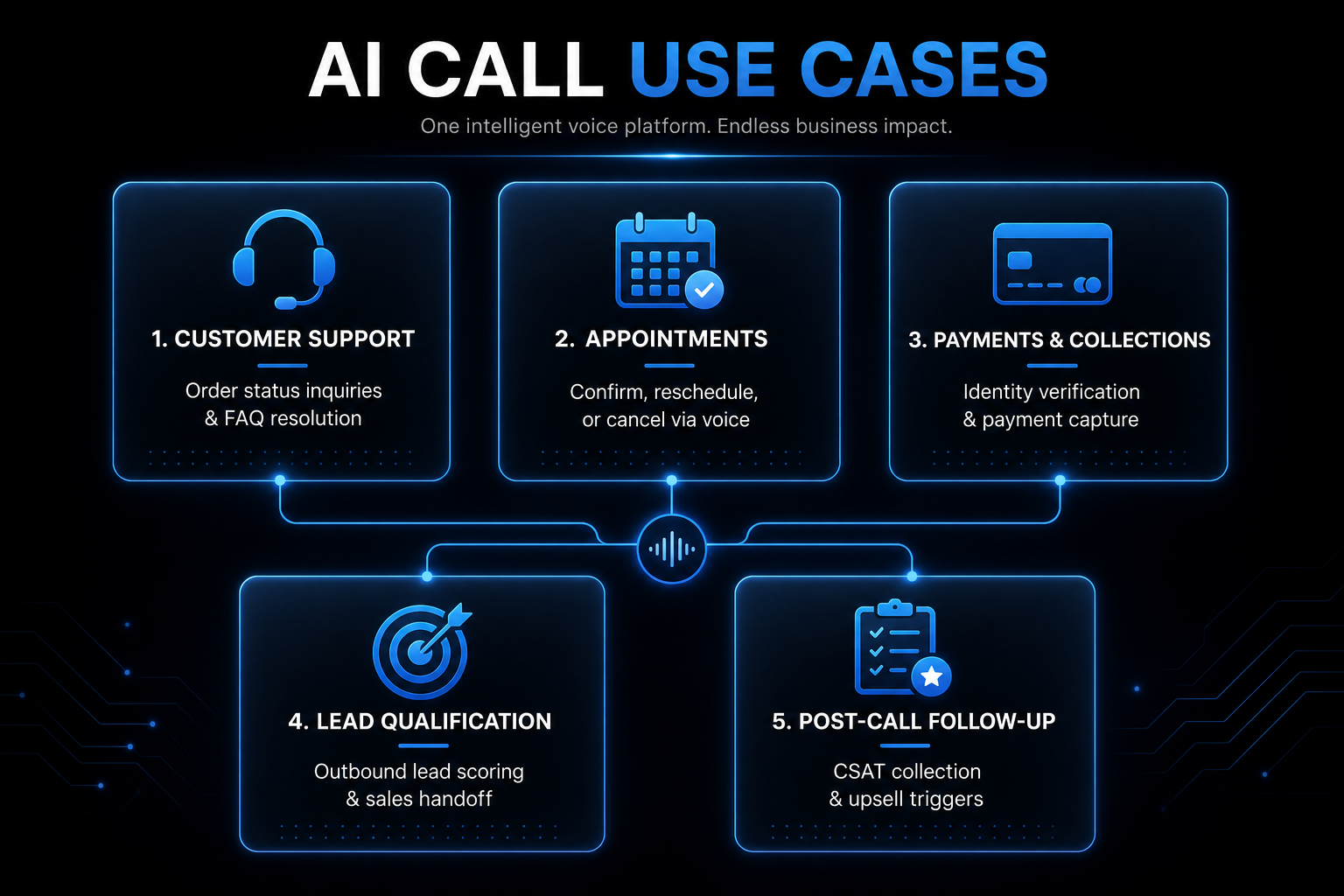
Customer support — Order status, account updates, password resets, FAQ resolution. The AI reads CRM context before the first word and writes outcomes the moment the call ends.
Appointment reminders and scheduling — Confirm, reschedule, or cancel via voice—for healthcare, field service, education, and logistics.
Payment and collections — Compliant identity verification, payment capture, and promise-to-pay recording. See collections for regulated patterns.
Lead qualification — Capture budget, timeline, and fit during an outbound call; push scored meetings directly to sales.
Post-interaction follow-up — CSAT surveys, next-step confirmations, and upsell triggers—automated at the close of every resolved interaction.
Benefits of AI Calls
- Always available — No hold queue. No lunch break. AI calls answer immediately, 24/7.
- Consistent quality — Every call follows policy-accurate scripts with no off-day variation.
- Real-time data — Agents read and write CRM records live—not in a batch overnight.
- Elastic scale — Handle 10 calls or 10,000 without adding headcount.
- Faster ROI — Pilot one intent in weeks, measure containment, expand with confidence.
Key Components of an AI Call Platform
| Component | Role |
|---|---|
| Telephony & carrier connectivity | Numbers, routing, compliance |
| Speech stack (ASR + TTS) | Low-latency, natural-sounding voice |
| Dialog orchestration | Intent handling, tool calls, escalation logic |
| CRM & tool integrations | Real-time reads and writes during the call |
| Conversation memory | Context across calls, channels, and sessions |
| Analytics & QA | Intent rates, containment, quality scoring |
Evaluate vendors on how these layers integrate—not on a single polished demo call.
Challenges With Legacy Calling Systems
Traditional call centers depend on headcount, rigid IVR trees, and batch data sync. Callers repeat themselves across transfers. Agents lack context at pickup. Scripts go stale for weeks before anyone updates them. The result: high abandonment, low first-contact resolution, and cost that scales linearly with volume.
Why AI Is Transforming Phone Calls
Better real-time speech models, tool-using agents, and flat support budgets are converging. AI calls let enterprises contain tier-1 volume autonomously—with human oversight, kill switches, and QA sampling—while routing complex cases to the right person the first time.
How Vanira Powers AI Calls
Vanira is an agentic voice AI platform built for production-grade inbound and outbound AI calls. It combines low-latency speech, CRM-aware orchestration, persistent memory, multilingual agents, and operator controls—all on one platform without per-language or per-product fees.
Start with one high-volume intent. Measure containment. Expand across queues and regions. Explore playbooks for BFSI, hospitals, and educational institutes.
Feature Comparison Table
| Feature | Traditional | Vanira AI Call |
|---|---|---|
| Natural language understanding | None or limited IVR speech | Native, real-time NLU |
| Inbound + outbound | Separate systems | Unified platform |
| CRM integration | Post-call batch sync | Real-time read & write |
| Conversation memory | None | Persistent, cross-channel |
| Multilingual support | Separate voice talent | Built-in, 20+ languages |
| Task completion (book, pay, update) | Human agent required | AI agent via connected tools |
| Human handoff | Blind transfer | Context-rich warm transfer |
| Iteration speed | Weeks per change | Hours with operator controls |
| Analytics | Call volume, AHT | Intent, containment, outcome |
| Scale | Headcount-bound | Cloud-native, elastic |
Why Businesses Choose Vanira for AI Calls
Faster pilots, multilingual voice out of the box, real-time CRM integration, and operator-controlled guardrails—without a multi-year IVR migration or separate inbound and outbound contracts.
Start Building Smarter Voice Automation With Vanira
Deploy AI calls for your highest-volume inbound queue or outbound campaign. Measure containment on real traffic, connect CRM data in real time, and scale across languages and regions—all on one agentic voice platform.
Frequently Asked Questions
Conclusion
An AI call isn't a robocall—it's a voice agent that understands, acts, and hands off with context. Start with one intent, measure honestly, and scale with guardrails. Vanira gives you the agentic voice infrastructure to make every call count.